


I grew up in a predominantly tribal, underdeveloped, Naxal-infected district. I did not have a lot of people around me I could look up to. When I was in Class 7, my family got me a Reliance Netconnect internet dongle, which was considered high speed back then. And that opened up an entire new world for me.
I discovered John and Hank Green on YouTube, discussing the personal and the political, reassuring me that being nerdy isn’t something to hide. I would spend hours falling down rabbit holes of random YouTube videos, some profound but mostly puerile. I wrote on Blogspot, happy just to see my words sitting beautifully on a digital real estate that was entirely mine. Later, when college gave me real broadband, I devoured books from Genesis Library and movies from the Pirate Bay. I did umpteen free MOOCs, squeezing Coursera’s financial aid like the last bit of toothpaste from the tube. The internet gave me the cultural vocabulary to pass off as someone who belonged in serious places. It let me live without my pincode tattooed on my forehead. The Internet is a beautiful thing. Everyone should have it.
Like a Router in the Sky
Last week, the Government of Meghalaya signed a letter of intent with Starlink India to pilot satellite-based internet across the poorly connected state. Meghalaya is not the first state to sign such an agreement (Gujarat, Goa and Maharashtra have done so earlier), but it may be the one handpicked to showcase what Starlink can bring to unconnected regions of post-Jio India.
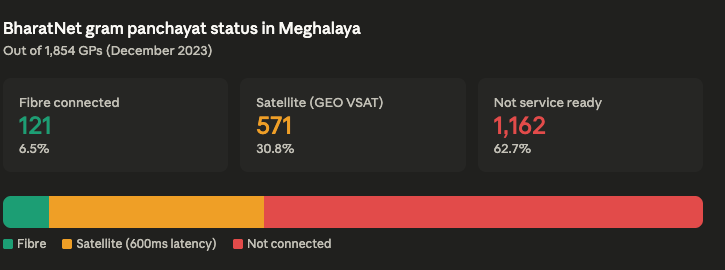
And Meghalaya needs it. According to a parliamentary reply by the Ministry of Communications in December 2022, 2,040 of the state's 5,623 villages, over 36 per cent had no mobile coverage at all. Under BharatNet, the government's flagship programme to connect every gram panchayat with broadband, only 6.5 per cent of Meghalaya's gram panchayats were connected via optical fibre as of 2023, against a national average of roughly 79 per cent. Another 571 GPs are classified as “service ready” on satellite, using older geostationary VSAT links with approximately 600 milliseconds of latency, which BharatNet’s own technical documentation acknowledges is unsuitable for low-latency applications. The remaining 1,162 GPs, 62.7 per cent of the total, are not service ready at all. And where connectivity does exist, it barely works. Digital payment transaction failure rates in the Northeast as a whole are 1.5 to 2 times the national average, driven by three times higher network downtime and 50 per cent slower speeds. Even in urban centres across the region, median wireless download speeds fall below the 20 Mbps threshold that the UN considers the minimum for usable broadband.
Yes, Starlink is great news. Perhaps the best connectivity news for underserved India in the last decade. But it’s also complicated.
Star Bucks
Starlink doesn't come cheap. Its India pricing is not yet known. A listing that briefly appeared on its website in December 2025 showed ₹8,600 a month and a ₹34,000 hardware kit, but the company said it was dummy test data. In Nigeria, a Starlink monthly subscription costs roughly $39 to $49, which works out to over 80 per cent of the minimum wage. In Kenya, annual Starlink costs range from 40 to 195 per cent of gross national income per capita, depending on the plan. We can expect promotional pricing at launch, possibly under $10 a month, to build a subscriber base fast. But even at the most aggressive pricing, the economics of satellite broadband do not make sense in regions that need it the most.
In Kenya, Karibu Connect, Starlink’s first authorized reseller in the country, uses a single Starlink terminal as backhaul for solar-powered community Wi-Fi hotspots, each covering roughly a square kilometre. Such a model, one that aggregates demand, shares costs, and distributes access through community infrastructure, is what India’s underserved regions need.
The Fault In Our Star(link)s
A constellation sees no national boundaries. It takes a State to point it at a map and teach it Borders 101.
In December 2024, unauthorised Starlink terminals were seized in India’s strategically sensitive Andaman and Nicobar Islands. That same month, a Starlink router and antenna, most likely smuggled in from Myanmar, were seized from the East Imphal district of Manipur. The north-eastern state has been embroiled in ethnic conflict since May 2023, and internet shutdowns have been imposed as a law and order measure. A Starlink terminal in the hands of a militia or an insurgent group renders an internet shutdown ineffective.
And India is not being paranoid for no reason.
Musk himself shipped thousands of Starlink kits to Ukraine within days of the Russian invasion, funded largely out of SpaceX's own pocket. Then, in September 2022, in the middle of a planned Ukrainian military operation against Russian forces in Crimea, Elon Musk unilaterally disabled Starlink access in the operational zone. As the journalist Ronan Farrow documented, it was one man’s risk assessment overriding a sovereign government’s military strategy.
In Brazil, Starlink terminals were found in the hands of illegal gold miners deep in the Amazon and among criminal networks in favelas. When a Brazilian Supreme Court judge ordered a ban on X, Starlink initially refused to comply, calling the order "illegal." Only after the court threatened to freeze Starlink’s bank accounts, did Starlink back down. In Iran, an estimated 50,000 smuggled terminals became one of the few channels for information during the 2025 internet shutdown. The state responded with drone surveillance, door-to-door seizures, and 25-year prison sentences.
Starlink increasingly shapes how states wage war, manage internal unrest, and fight crime. A government can ban Huawei or TikTok, and life goes on. But you cannot take away the internet from an entire region without consequences that ricochet through everything — schools, hospitals, banks, businesses, governance, and obviously, the lives people actually live. If Starlink fills the vacuum where no other connectivity exists, then acting against the company means disconnecting your own people. And that is a digital Strait of Hormuz.
Loading... (2021-2026)
India, to its credit, isn’t taking any chances either. It has adopted a full bomb squad approach, with all protective gear, making one careful snip at a time. Starlink opened pre-orders in February 2021, signed up over 5,000 customers, and set a target of 200,000 terminals by December 2022. Within months, the government issued a public warning asking citizens not to sign up, the country head resigned, and all pre-orders were refunded. The licence application with DoT, which would allow it to offer satellite internet services commercially in India, filed in November 2022, took over two and a half years to process. Along the way, Starlink’s progress required a Modi-Musk meeting in New York, a Modi-Trump-Musk meeting in Washington and a spectrum allocation battle that pitted Ambani and Mittal against Musk before both ended up signing distribution partnership deals with Starlink.
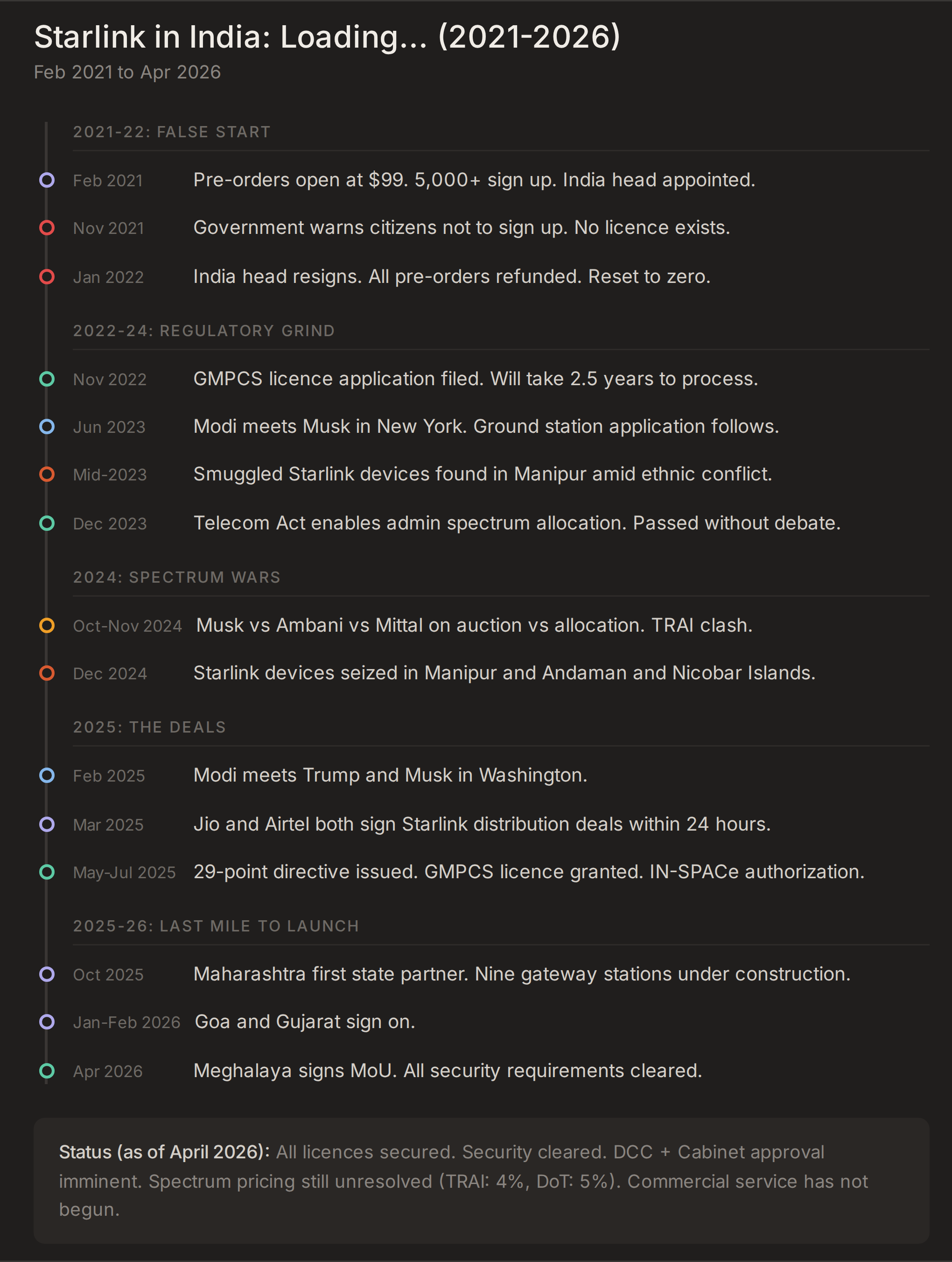
The 29-point compliance directive issued in May 2025 is arguably the most demanding laundry list of regulatory requirements any country has imposed on satellite internet providers. It mandates real-time location tracking of user terminals, data localisation on Indian servers, metadata sharing with law enforcement, website-blocking capability on demand, traffic routing exclusively through Indian ground stations, surveillance zones near international borders, compliance with internet shutdown orders, and 20 per cent indigenous manufacturing of equipment. As Irina Tsukerman, a national security lawyer, put it:
Starlink’s entire model is built on global interoperability, low latency, and centralized deployment. India wants the opposite: fragmented control, localized nodes, and bilateral oversight.
The IN-SPACe authorisation, granted in July 2025, caps the constellation at 4,408 satellites. The government has capped maximum connections at 20 million users. As of April 9, 2026, Starlink has cleared all security requirements set by law enforcement agencies. Digital Communication Commission (DCC) approval and Cabinet sign-off are potentially weeks away. The four-year obstacle course is nearly over, except for a disagreement between TRAI and DoT on spectrum pricing.
India has also licensed competitors — Eutelsat OneWeb, Jio-SES, AST SpaceMobile via Vodafone Idea, with Amazon's Kuiper in the queue. But satellite spectrum has not been allocated to any of them, and without it, no one can actually operate. This diversification strategy needs to be actively pursued. No single foreign provider should become the sole source of satellite connectivity for India’s unconnected regions. Even Taiwan, an American ally, wary of Musk’s business ties to China where Tesla operates several large factories, chose to partner with Eutelsat OneWeb instead of Starlink.
A Moonshot Beyond Starlink
So we allow Starlink in the short term. We regulate hard, ensure enough competition in the medium term. But what about the long term?
Countries are waking up to the risk of dependence on a single foreign satellite internet provider, especially one led by Elon Musk. And some of them are placing expensive bets to tackle it. China is building Guowang, a 13,000-satellite sovereign constellation. The European Union has committed over $11 billion to IRIS², a sovereign satellite system with both secure government and commercial broadband functions. Russia and Ukraine are building their own constellations for strategic autonomy.
India, conspicuously, is doing none of this. Apart from one stray remark by an ISRO official at a conference in August 2025, claiming 140 LEO satellites had been “worked out” on paper for urban broadband, the government has been silent. India’s official space policy since 2020 has moved decisively in the other direction: opening the sector to private players, transferring ISRO technology to industry, and licensing foreign operators through IN-SPACe.
So here is where I bring up Digital Public Infrastructure.
I know. DPI has become the hammer that makes everything look like a nail, especially in Indian policy spaces. But before you roll your eyes, hear me out.
India doesn’t need one company with 7,000 satellites to compete with Starlink. It needs an ecosystem where twenty startups with 30 satellites each can collectively function as one network. Let’s call it Open Rails for Broadband Internet Transmission (ORBIT). We standardise the user terminals so a single dish works across constellations. We standardise the inter-satellite links so satellites from different operators can handshake and route data between each other. We build and operate shared ground stations so every small operator doesn’t need to replicate SpaceX’s global gateway network. This can be done by a consortium of operators working with an ISRO subsidiary, like NPCI does in case of UPI. Individual startups then innovate over what remains: antenna design, coverage optimisation, uplink and downlink capacity. The shared infrastructure handles the interoperability, the spectrum coordination, the traffic orchestration. Spectrum allocation at preferential rates, government procurement and subsidized satellite launches by ISRO can be used as carrots to incentivize participation in the network. Such a DPI for satellite internet would drop the minimum viable constellation from thousands of satellites to dozens.
The security concerns are real and I have not tried to push them under a compassionate rug. But we cannot keep a large part of our population away from the internet. If national security requires keeping foreign satellite providers at arm’s length, then the State must fund the alternative itself. If the tower economics in the Northeast don’t make sense for a Jio or an Airtel, it is the State that has to make it work. But it hasn’t. You cannot invoke sovereignty to slow-walk Starlink and then offer nothing in its place. You cannot put the burden of sovereignty on the already underserved. Because, to repeat what I said at the start, the internet is a beautiful thing. Everyone should have it.
*The usual disclaimer: views here are entirely my own.
This post is so good, it almost made me root for the DPI! And ORBIT for acronym is brilliant!
I disagree with the security argument. Inability to enforce an internet ban on a region should not be a reason to deprive people of internet, as you've beautifully narrated. Besides, disabling the internet isn't a goal in itself but a tool for controlling difficult situations.
But this is seriously good, and the BharatNet service data visualisation is excellent!