


In 1997, as the Asian Financial Crisis rocked economies across the region, South Korea embarked on one of the most aggressive deregulation drives in history. Every regulation was to pass through a committee and justify its existence. Those with low compliance rates, poor cost-benefit ratios, and those misaligned with global standards were eliminated. Within a year, Korea had cut nearly half its regulatory bloat. In her Budget Speech last year, finance minister Nirmala Sitharaman highlighted efforts to reduce the “excessive regulatory burden” on the Indian economy. A Korean-style regulatory guillotine may be too bloody for India’s taste. But the scissors are finally out.
Finally, Some Self-Awareness
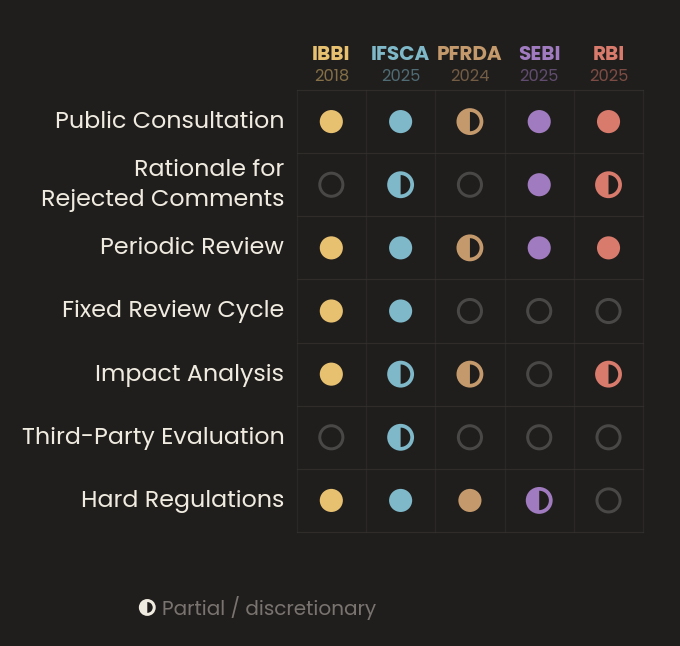
Last May, RBI brought in a framework that, for once, regulates its own conduct. And it’s not the only one going meta. Earlier in February, SEBI too issued a regulation to regulate… how it regulates. While this may seem like a case of regulators tying themselves up in their own red tape, these regulatory urges are not coming from nowhere. Last year’s Economic Survey makes a case for a “systematic” procedure for regulation making, one that is “fair, accessible and open”. And this shift has been a long time coming. The report of the Financial Sector Legislative Reforms Commission (FSLRC), a treasure trove of ideas on reforming India’s financial sector, had recommended these steps over a decade ago. RBI and SEBI are actually a little late to the party. IBBI had already put similar regulations in place as far back as 2018.
While India’s regulators are still taking baby steps, the US had already institutionalized this regulatory mindfulness in its Administrative Procedure Act in 1946. The EU’s ‘one-in, one-out’ rule forces it to cut an equal amount of red tape before making businesses jump through new hoops. The EU, as well as the UK and Australia, have independent bodies at the federal level that screen new regulations.
Heard, Not Heeded
The new rules codify a lot of what the regulators have already been doing. They require regulators to publish draft regulations for public consultation. That means no more regulatory ambushes. Regulators must cite exact legal provisions that empower them to make a regulation, ensuring they stick to their mandate. And they will have to clearly spell out the objectives behind regulations, so that the public can judge if it is genuinely designed to fill a gap, and if it’s summoning a hammer where a scalpel would have done. They also need to allow enough time, no less than 21 days, for comments on the proposed regulation. This signals a genuine push towards making consultation more participatory and not merely performative.
But is this enough? A regulator can nod politely at suggestions and then ignore them. RBI has promised a “general statement of its response”. But this gives it enough room to avoid publishing certain comments. SEBI, however, requires itself to give detailed rationale for rejected comments. IBBI publishes all comments it receives, and even when not required to, has provided rationale for rejected comments. Of course, there are times when an urgent regulation is required. This is allowed, but no regulator has yet specified that such measures should lapse after a fixed period unless replaced through the full procedure.
Don't Ask the Chef if the Food is Good
Now what happens if a regulator simply says, “We disagree,” and moves on? There’s really nothing stopping them. Without external review, the whole process risks turning into a mere ‘check-the-box’ exercise. RBI’s choice to bring in these requirements in the form of a softer “framework”, instead of hard “regulations” as other regulators have done, is also telling. This may give RBI flexibility to sidestep them, especially when the framework itself provides plenty of exceptions.
New regulations make headlines. Their reviews rarely do. There’s a perverse asymmetry at play here. Policymakers love to announce new regulations, but few check if they have actually worked. Regulations are policy experiments and even after going through a rigorous consultative process and analysis, some fail. Most regulators require a regular review of regulations now but only IBBI has mandated a fixed three year cycle.
RBI now requires itself to conduct an impact analysis for any proposed regulation. More elaborately, IBBI requires an economic analysis covering the cost and benefit to society, the economy, and other stakeholders. An obvious problem here is the confirmation bias intrinsic in marking your own homework. Even with the best intentions, it can start to resemble Michael Scott’s “World’s Best Boss” mug. So, such impact assessments must be validated by independent third-parties.
Good Faith Has an Expiry Date
Here again, IBBI has shown the way. In 2021, it commissioned an independent think tank to evaluate its performance. And evaluate it did. It noted that the regulator had sometimes missed its mandatory three-year review timeline. It also flagged the poor quality of its economic impact analyses. IBBI isn’t perfect, but by opening itself up to third-party scrutiny and publishing the findings, it demonstrated a rare willingness to be held accountable.
What IBBI has done voluntarily, every financial sector regulator should be required to do by law. Even IBBI, whose earlier leadership pioneered these efforts, has not repeated the exercise since. The model is straightforward: a mandatory, periodic third-party evaluation of each regulator’s rule-making conduct, covering consultation quality, impact assessment rigour, and review compliance, with findings made publicly available.
In India, CAG traditionally audits regulators on financial matters and Parliament’s Public Accounts Committee may conduct a wider exercise occasionally. But neither is a substitute for a regular, targeted structure that evaluates regulators on their core function — how they regulate. That gap needs filling. A single independent body, mandated by legislation, auditing all financial sector regulators on this one question alone is both achievable and overdue. After all, who better than a regulator to understand the value of oversight?
*The usual disclaimer: views here are entirely my own.