

There is a scene in Bertolt Brecht’s Life of Galileo where the students wait to see whether Galileo, their teacher, will stand firm before the Inquisition or take back everything he has taught them. Galileo is more Aristotle and less Socrates. He does the less heroic thing. Andrea, one of his pupils, is furious. As Galileo walks in, Andrea says, “Unhappy the land that has no heroes!” Then Andrea screams, “Winebag! Snail-eater! Have you saved your precious skin?” Galileo calmly asks someone to give him a glass of water. “No. Unhappy the land that is in need of heroes,” Galileo replies.
Which brings me to Maharashtra, and to Tukaram Mundhe.
Mundhe took over as Maharashtra’s Food and Drug Administration (FDA) Commissioner in May. Within weeks, his inspectors found rats and flies at K Rustom & Co, Mumbai’s famous ice-cream parlour. They found dirty utensils and unhygienic storage at Noor Mohammadi, a 102-year-old establishment known for its Nalli Nihari and its signature Chicken Sanju Baba. In the first 100-days, the FDA had completed more than 12,000 inspections, served more than 5,200 improvement notices and suspended more than 600 licences. This revolution was televised and printed and reel-ified. Before long, the Indian news media, displaying their usual boundless imagination, were calling him… wait for it… SINGHAM.
The Imitation Games
“Imitation is the sincerest form of flattery that mediocrity can pay to greatness”, says Oscar Wilde. The same holds in public policy. Matt Andrews, Lant Pritchett and Michael Woolcock call it “isomorphic mimicry”. Governments in the developing world often adopt the form of successful institutions without acquiring their function. The laws, regulations and institutions look like their counterparts in the developed world but function nothing like them. Looking capable, instead of actually being capable, is cheap and earns them legitimacy and funding.
They describe how after the civil conflict in the Solomon Islands, donors decided a weak criminal justice system was part of the problem and financed a state-of-the-art courthouse. It was, in their words, a donor’s delight. It met every administrative requirement, looked impressive, photographed beautifully and even caught the sea breeze, which let it claim a low carbon footprint. It was also barely used. Less than two blocks away, a police station sat backlogged with hundreds of cases, most of which never needed a courthouse in the first place.
Shruti Rajagopalan and Alex Tabarrok identify a related problem they call “premature imitation”. The Indian elites try to replicate laws from richer countries long before the Indian state acquires the capacity to enforce them, they write. The people who write and influence Indian policy are English-speaking, largely upper caste and often foreign-educated. They participate in the same intellectual conversations as their counterparts in Europe and the United States. To them, the laws of richer countries simply look normal.
Singham Simulacrum
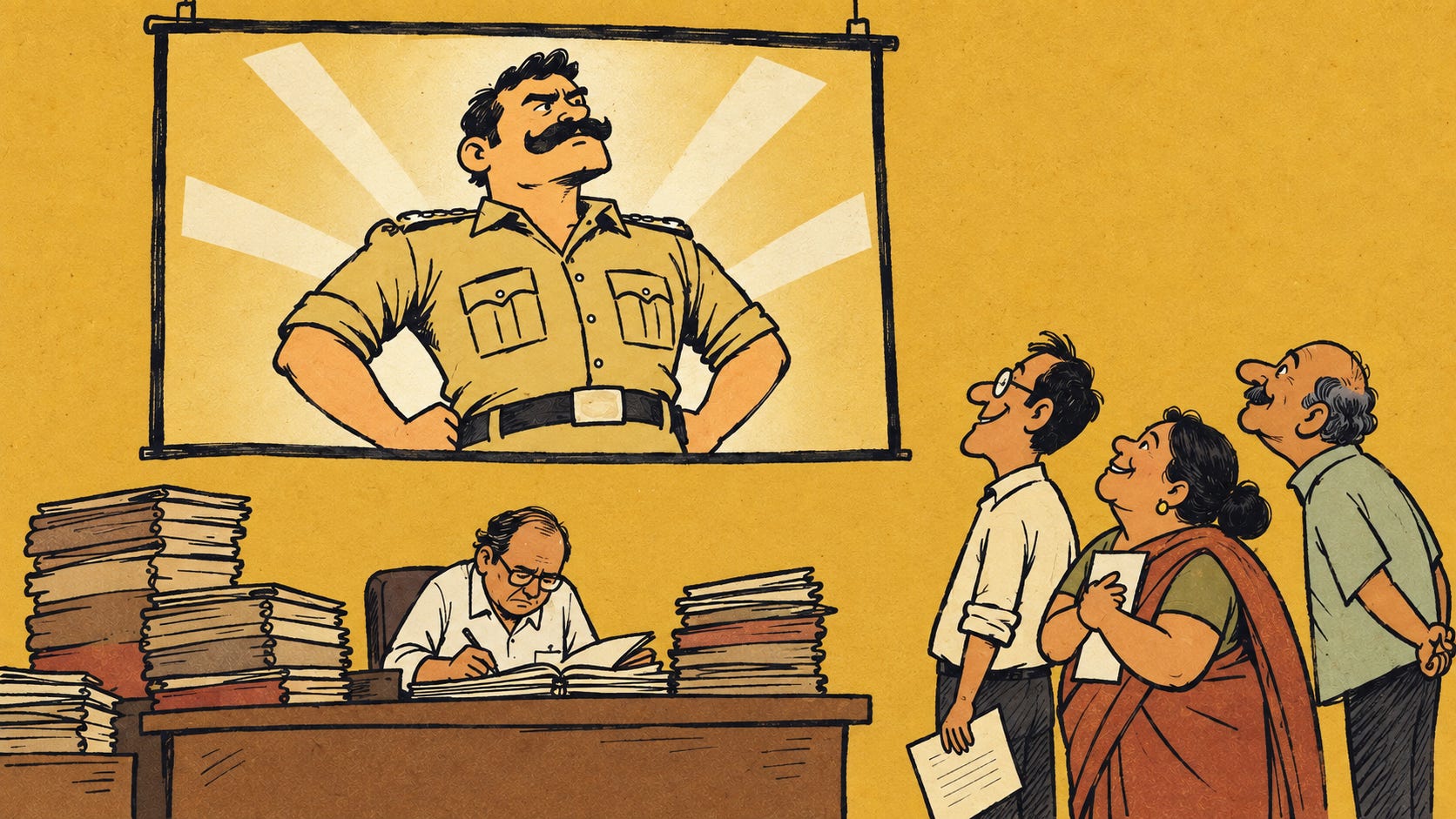
I would like to submit one more term to this tradition, one I totally made up (because why not?). I call it “cinematic mimicry”. And if that isn’t academic enough for you, how about Singham Simulacrum? In this Bollywoodian theory of the State, the system is rotten because the people in it are rotten. The State’s failures are moral failures and moral failures need moral heroes. And salvation finally arrives as one honest man. He, for some reason, almost always has a moustache. Cinematic mimicry begins when public officials start borrowing this script. Playing the hero becomes a substitute for making the system work.
Obviously, I am not blaming Rohit Shetty for the state of food safety in India (though maybe I should blame him for road safety). Films sell what audiences already want. Some senior police officers find encounter killings distasteful but still condone them because the public demands them, writes Karthik Muralidharan. The public is frustrated with slow investigations and even slower courts. It is looking for someone who can visibly get past these failures.
Deal Ya No Deal
Rajagopalan and Tabarrok point out that Mumbai’s restaurant inspection system is on paper at least as demanding as America’s (partly a result of premature imitation). They have been told that it would be difficult for any restaurant to operate if it had to meet every requirement. Writing about labour laws, Manish Sabharwal makes a similar point. Nobody could comply with 100 per cent of the laws without violating 10 per cent of them. In his words, India’s labour laws were neither pro-labour nor pro-employer but pro-labour inspectors.
A New York health inspector earns more than he would elsewhere. So, a bribe risks a job worth keeping. And a restaurant owner who offers a bribe to an honest inspector risks much worse than just a bad grade. Mumbai has the same regulations but far lower inspector wages and far fewer inspectors per restaurant. The equilibrium flips and deals make sense to everyone in Mumbai. Rajagopalan and Tabarrok describe what Mark Kleiman calls “enforcement swamping.” A small squad of inspectors can catch most offenders when only a few are offending. But as the number of offending businesses rises, the chance of being caught falls. Establishing a restaurant inspection system in a developing country, they write, “can be like trying to create law and order during a riot.” More regulation, they argue, can make the problem worse by increasing the incentives to offer and take bribes.
Andrews, Pritchett and Woolcock ask, “Who wants rules when they can have deals?” When formal regulations exceed what an organisation can actually implement, compliance breaks down into case-by-case arrangements. The relationship between a particular firm and a particular official becomes more important than whatever the rules say.
AFP reported in August that Maharashtra has fewer than 400 officers, against rules requiring more than twice that number. With more than 1.2 million active licences, that is about 3,000 businesses per official. Mundhe’s drive ran about 12,000 inspections in its first hundred days, which works out to roughly 44,000 a year if the pace holds. Against 1.2 million registrations, that is a full cycle once every 27 years.
When the state promises a hundred times more than it can deliver, selective enforcement becomes the default. That selection should ideally be based on something rational, like risk. But more often than not, it is visibility, political pressure and bureaucratic incentives that matter. FSSAI runs a Risk Based Inspection System that sets inspection frequency by the risk a business poses. Ranking businesses by risk itself requires knowing something about them in the first place. This includes what previous inspections found, whose samples failed, where people got sick. But how do you rank a business when you can inspect it only once in a generation?
Indian Personnel League
Andrews, Pritchett and Woolcock argue that pockets of success in a weak system are “effervescent, small bubbles that shoot up and disappear.” Drawing on Kapur and Mehta’s work on Indian institutions, they describe a life cycle in which reforms are born and die at about the same rate. There is always a stream of reform but no forward progress. As long as a reform depends on a particularly engaged and determined civil servant, they write, it will often disappear with the officer.
Karthik Muralidharan notes that the average IAS officer stays in a post for about fifteen months. One senior officer told him it felt like batting in a T20 match. With that little time at the crease, you hit out from the first ball. Building a regulator is Test-match work, where nothing much appears to happen for long stretches.
Mund(ane) Matters
Mundhe matters. But the mundane matters more. Andrews, Pritchett and Woolcock, who are hardly romantics about heroic administrators, argue that capability comes from people solving real problems and turning what works into routine. Success leads to successful institutions, rather than the other way around. Someone has to deliver those early wins and help move the system towards a better equilibrium. Mundhe has shown that enforcement is possible even against popular, high-profile restaurants. What’s required is to make the things that worked a stable part of food safety inspections. But I wonder what remains if you take Mundhe out.
His drive has shifted what the public expects and raised the political cost of ignoring food safety. But the real value lies in what he does with the attention while he has it. The question to ask about the FDA is not just how many licences were suspended this year. It is whether the department is becoming better equipped to do this work without him. Do district officers have the training, testing facilities and political support to act before the commissioner turns up? Will his successor inherit better working routines, or have to start from scratch? “The Best Leaders Build Systems That No Longer Need Them,” Mundhe posted on X on 6 August.
My samosa may, after all, need a hero. But more than that, it needs a food safety department that still works after the hero has been transferred.
*The usual disclaimer: views here are entirely my own.
This was a fantastic read. I often wonder since India has a lack of state capacity why don’t political parties promise things like say - “We will hire X number of people over Y number of years” in their manifesto, seems lucrative politically as well.
Very well said.